Computing Sovereignty and Europe’s Security Future
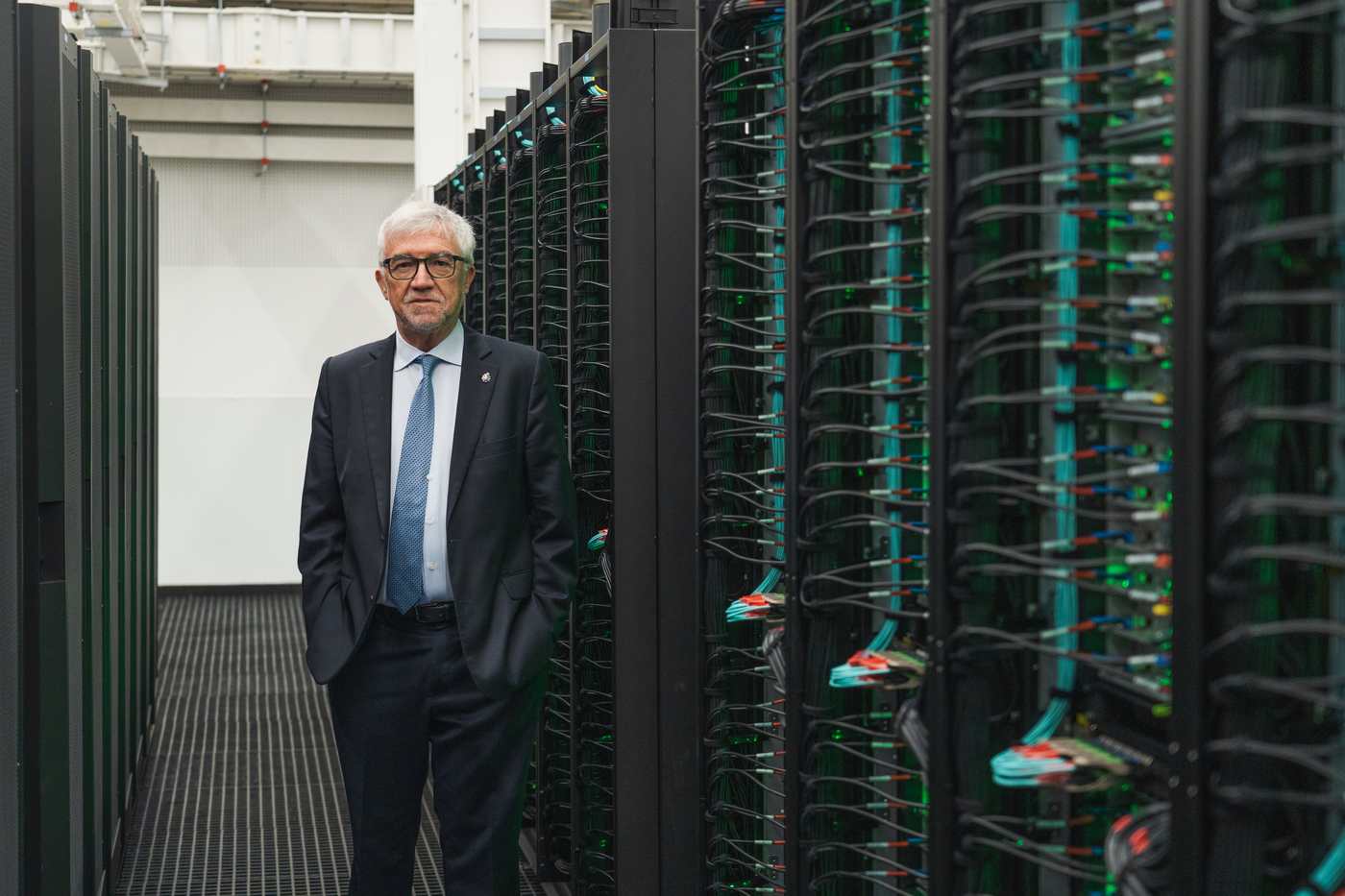
A Conversation with Mateo Valero, Director of the Barcelona Supercomputing Centre
Artificial intelligence is reshaping how organisations manage people, facilities, and critical infrastructure. As workforce management platforms become smarter and security systems increasingly converge with data analytics, a fundamental question emerges: who controls the technology behind these capabilities?
For Europe, the answer extends beyond innovation. It touches on digital sovereignty, resilience, cybersecurity, and long-term competitiveness.
To discuss these challenges, Federico Winer, Innovation Analyst at Primion, spoke with Mateo Valero, founder and director of the Barcelona Supercomputing Center (BSC) and one of Europe’s leading voices on supercomputing, artificial intelligence, and semiconductor strategy.
Their discussion explores why computing power is becoming a strategic asset, what it means for workforce and security technologies, and how Europe can strengthen its position in an increasingly competitive digital landscape.
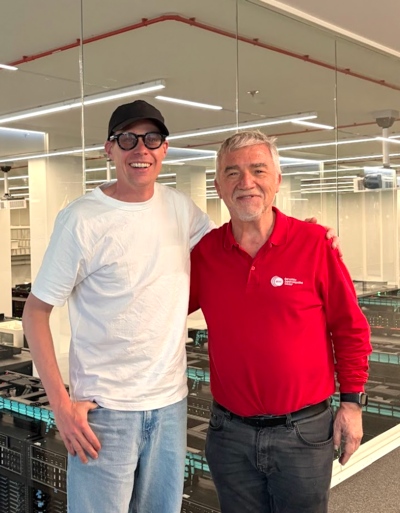
Dr. Federico Winer (Primion) and
Prof. Mateo Valero Cortés (BSC)
The Core of Modern Sovereignty: Microchips and Computing Power
Federico Winer:
You emphasise that technological sovereignty and microchips are vital. Why is that?
Mateo Valero:
“Without chips, there is no paradise. We are living through an immense technological revolution, but processors are the fundamental engines that make everything work. Today, the true sovereignty of a nation is no longer exclusively measured by weaponry, but by computing capacity, by the massive volume of data a State possesses, and by the artificial intelligence (AI) tools it commands. Without that, sovereignty is practically non-existent.
It is a profound problem that is often misdiagnosed. The real trap isn’t debating where to install data centres. By owning the entirety of global hardware, the Americans hold the absolute capacity to decide, unilaterally, if the rest of the planet gets operational machines. If they cut off our supply, we are completely lost.
In AI, two massive blocs have consolidated: the United States and China. North America tried by all means to suffocate the Chinese so they couldn’t manufacture fast chips, but they failed. The Asians comfortably handle 7 and 5-nanometer technology compared to the West’s 3. A few weeks ago, I visited the most powerful supercomputer in the world (LineShine in Shenzhen); and yes, it is one hundred percent Chinese.“
Federico Winer:
How does public science compete against tech giants like Google, Meta, or OpenAI?
Mateo Valero:
“It is an unequal fight because they dedicate up to a hundred times more money, whereas true foundational science is born in public universities. Furthermore, the United States fosters closed ecosystems; Trump even banned transfers by considering algorithms as national weapons. Conversely, China is currently betting on open models to try and attract the West.“
Federico Winer:
What role is left for Europe in this geopolitical technological map?
Mateo Valero:
“Europe needs to apply a radical shift. Our greatest and gravest obstacle is that we do not act under a united flag. There is an alarming lack of leadership from a political class that simply doesn’t grasp the strategic gravity of supercomputing or of designing our own chip architecture. It is a complete fantasy to pretend to develop beautiful ideas about ethical and private AI if we do not possess physical and structural control. If the entire architecture relies on hardware designed and patented abroad, they will always have us cornered and controlled in perpetuity.“
Federico Winer:
Is it genuinely viable to design chips from scratch in Europe to compete with the global powers?
Mateo Valero:
“It is entirely viable and is already happening in Catalonia. We took the step because the ecosystem opened a door for us through the revolutionary concept of “open hardware,” fully supported by the RISC-V architecture. This tool represents the exact same qualitative leap that Linux offered for operating systems. It allows us to freely use public instructions to build custom processors.
As we approach the physical limits of miniaturisation, the priority becomes the enormous flexibility to assemble different types of chips. Having open hardware within reach, we only need a firm and united governmental will to plan it once and for all.“
Federico Winer:
How do you compete against the gigantic software ecosystems that Intel or Nvidia already have?
Mateo Valero:
“That is the turning point where the true battle is defined. Manufacturing the processor core is just the tip of the iceberg; afterward, you need that silicon to run programs efficiently. Companies like Intel or Nvidia enjoy a historical monopoly because they have tons of pre-optimised applications.
However, the devastating impact of the open RISC-V initiative is that you simultaneously have armies of researchers worldwide programming improvements for that standard. Thanks to this collective work, I guarantee that in less than ten years, RISC-V processors will sweep in and conquer total market dominance. Europe is obligated to get on board.“
Federico Winer:
Do current global communications and monopolies worry you?
Mateo Valero:
“Very much so. Global connections depend on highly fragile oceanic cables and satellite systems controlled by a single monopoly. Elon Musk today holds a level of geopolitical power that is far superior to the scientific sphere; if he decides to cut the signal of his satellites, he leaves Ukrainians under Russian fire for two days straight.“
Federico Winer:
What urgent and real problems will quantum computing manage to solve?
Mateo Valero:
“Although quantum is going through a “polar winter,” the advances are solid. They solve problems that would take a classical supercomputer thousands of years. They operate with entirely different calculation systems, dropping the temperature to the extreme to create superconductors. Today, with just 25 qubits, you can process mathematical operations of tremendous complexity. They face stability and reliability challenges, but they will surprise us very soon. This technology, combined with fusion energy, will be vital to mitigate climate change.“
Federico Winer:
When will doctors test treatments on “digital twins” before medicating us?
Mateo Valero:
“My greatest dream and the ultimate challenge of science before I retire is to achieve the complete digital twin of the human body and brain. It is a fascinating challenge because nobody yet knows with absolute certainty how a single neuron truly works.“
Federico Winer:
There are concerns about the use of these technologies in the real world: unemployment, data, security, … What makes you optimistic about the future?
Mateo Valero:
“Every revolution has created uncertainty, but it has also generated extraordinary opportunities. The key is ensuring that we develop these capabilities responsibly. If Europe can combine technological excellence with its commitment to security, privacy, openness, and human-centred innovation, I believe we can build a future that is both competitive and trustworthy. That is a future worth pursuing.“
Federico Winer:
Finally, will we be able to create an AI that does not dominate us?
Mateo Valero:
“Every key technology throughout history has a dual use; misused it does immense damage, but it is vital. I fully trust that, as humanity, we will find the right path to forge an AI that is ethical, friendly, controllable, and truly cooperative to solve the problems of the future.“
Behind the Scenes: A Supercomputer in a Chapel
Federico Winer:
Why house the MareNostrum supercomputer in an old religious chapel?
Mateo Valero:
The central objective was to pass the demanding Top 500 tests, which measure and rank global supercomputer performance. We ran into the problem that there was absolutely no other space available at the university with the necessary dimensions. The professor was pragmatic: ‘What better use for a chapel than to house a great computer?’
Anecdotally, this exotic location gave us great stories. The writer Dan Brown visited us, saw the machine wrapped in that mystical aura, and it inspired his famous novel Origin. On the other hand, my extremely religious mother stopped speaking to me for a month; she accused me of going to hell for sinning. But the place was already deconsecrated and functioning as a classroom. Regardless, there must always be a bridge between knowledge and spirituality.“
About Mateo Valero
Prof. Mateo Valero Cortés is the founder and director of the Barcelona Supercomputing Center (BSC), Spain’s national supercomputing centre. Under his leadership, the BSC has become one of Europe’s leading research institutions in high-performance computing, artificial intelligence, chip architectures, and digital innovation. The centre operates MareNostrum 5, one of the most powerful supercomputers in Europe.
About the Author
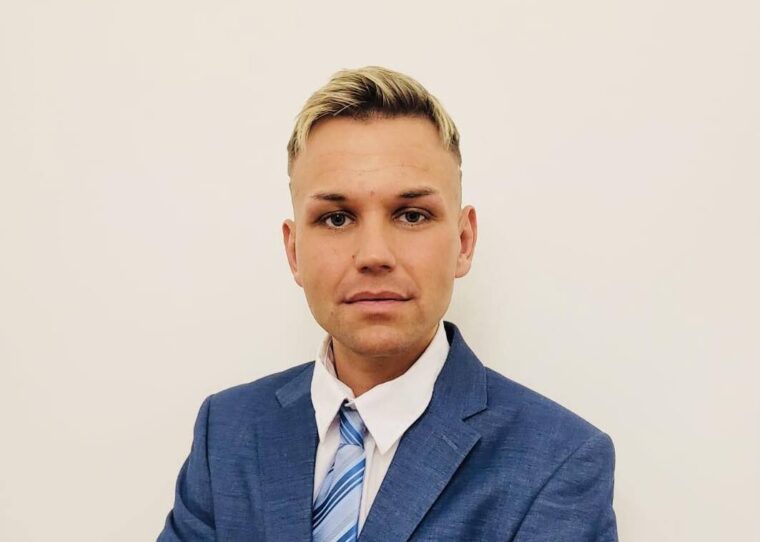
Dr. Federico Winer is an Innovation Analyst at Primion. His work focuses on emerging technologies, AI-driven business transformation, workforce management innovation, digital resilience, and the future of converged security across Europe.
Other articles
Computing Sovereignty and Europe’s Security Future
Primion makes AI powered video intelligence available for converged security in Europe

Checklist: How to build defensible time records in a moving workforce
Observability: turning data chaos into business clarity

From Physical Security to Cyber Awareness