Access Granted: A day at the Uzbek Embassy in Berlin
I work with systems that decide who gets through a door. Credentials, readers, audit trails, the whole apparatus of controlled entry. So there is a certain professional irony in the fact that one of the most pleasant access experiences I’ve had all year involved no badge, no PIN, no biometric enrolment; just a handshake at the door of the Uzbek Embassy in Berlin and someone saying, warmly, kiring (come in).
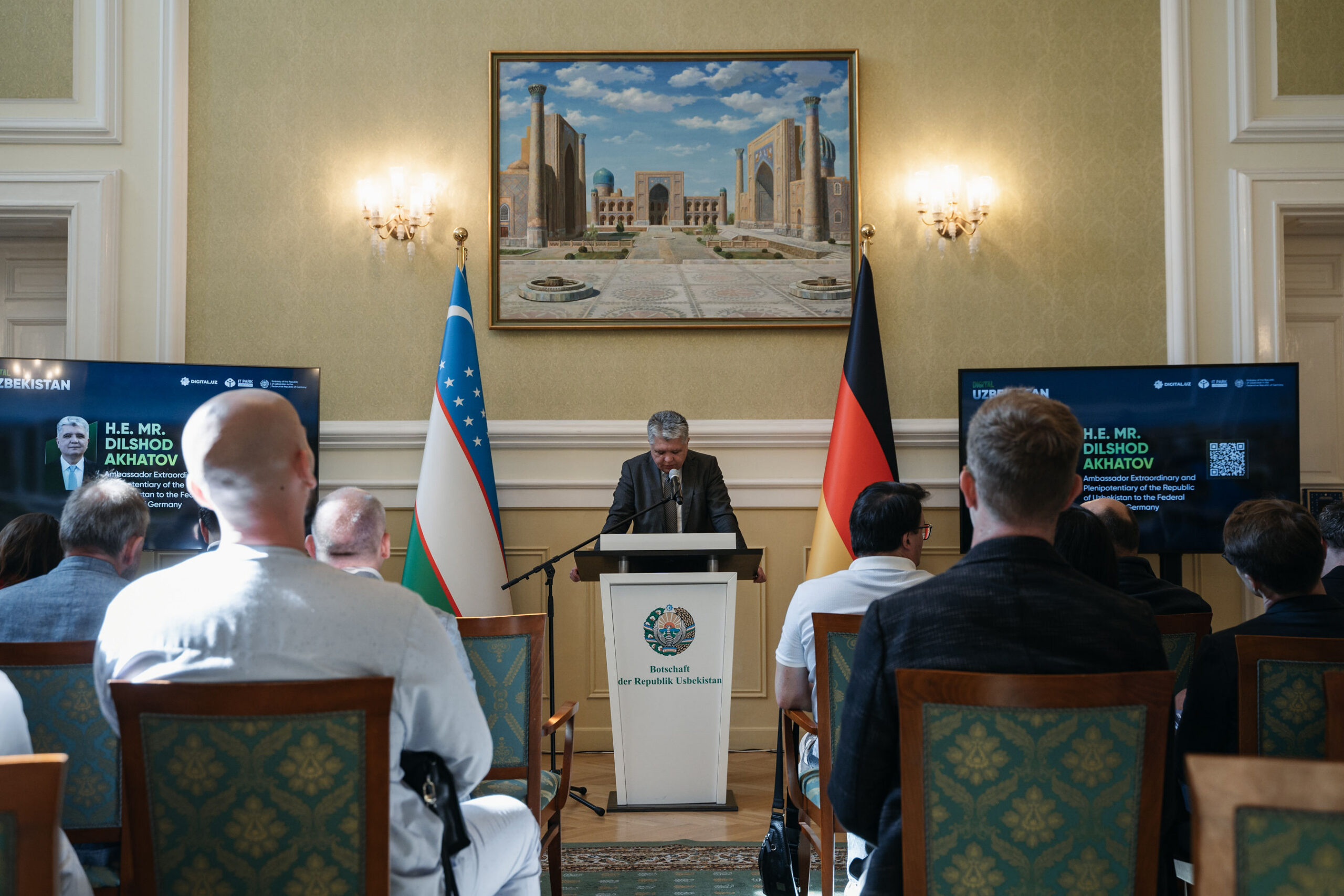
Let me start with the building, because it deserves it. I have been inside a reasonable number of embassies in Berlin. This one is extremely beautiful. Gold trim, a very good painting of the Registan on the wall, parquet that has clearly outlived several governments, and chandeliers doing honest work. I spent the first four minutes appreciating the architecture and the fifth minute quietly working out where I would mount the readers. Occupational hazard. The answer, for the record, is nowhere. Leave it alone.
The event was Digital Uzbekistan, hosted by the Embassy together with IT Park Uzbekistan and Digital.uz. Mr. Dilshod Akhatov, Ambassador of the Republic of Uzbekistan to Germany, opened the programme. He did the thing that good hosts do and bad conference speakers never manage: he was brief, he was precise, and he did not oversell. There was no talk of disruption. Nobody’s journey was described as a journey.
Then the substance.
Every country in the world currently has a slide deck about becoming a technology hub. The slides are broadly identical — a map, an upward arrow, a stock photo of young people looking at a monitor with unnatural enthusiasm. What distinguishes the countries is whether anyone behind the slide can actually ship software. Uzbekistan brought the people who ship. IT Park has gone from an idea to a functioning ecosystem in a genuinely short window: resident companies, export-oriented delivery teams, a serious pipeline of engineers coming out of the training programmes, and a tax and residency framework that makes the economics work rather than merely making a press release possible.
There was a QR code on the presentation screen. I scanned it. It resolved, immediately, to the correct page. In my industry this counts as a demonstration of end-to-end system integrity and I would like it noted in the minutes.
The networking was the good kind — the kind where people tell you what they actually build instead of what their brand stands for. Founders, integrators, embassy staff, a handful of Germans slowly recalculating how far away Tashkent really is. It is closer than the mental map suggests, in flight hours and in working culture. For anyone in security, access control, building technology or industrial software, this is a market and a partner pool worth a second look before everyone else looks.
And then, plov.
I want to be serious about this for a moment, in my own way. Plov is a load test. Anyone can produce one good plate in a quiet kitchen. Delivering it warm, at correct rice-to-fat ratio, to a full room of people who all arrive at the same moment, is an operational readiness problem. The embassy team in Berlin passed the test without visible strain, which tells you more about how this event was organised than any agenda could.
I left with a notebook, conversations that will outlive the session, no visitor badge to hand back, and a plan for 2027 that is now partially rice-based.
Thank you to the Ambassador, the embassy team, and everyone at IT Park Uzbekistan and Digital.uz. Access granted, and gladly.
Federico, Head of Solution Management
Let’s talk possibilities!
Every project on this page started with a conversation about a real operational challenge. Bring us yours, and let’s explore what a working prototype could look like.