From products to networks to people. What stayed with me after InnoTrans 2026
After my first lap around the 42 halls, I went back to the stands that had stayed on my mind. Four of them showed very different sides of transport innovation.
Deutsche Bahn: AI meets the traveller
The real draw at the DB exhibit was a live demo of its new AI agent for itinerary planning. A steady crowd gathered to try it, typing in destinations and watching the agent build their trips. It was interesting to see a real-world example of AI interacting directly with the passenger, a clear sign of where AI is heading in transport.
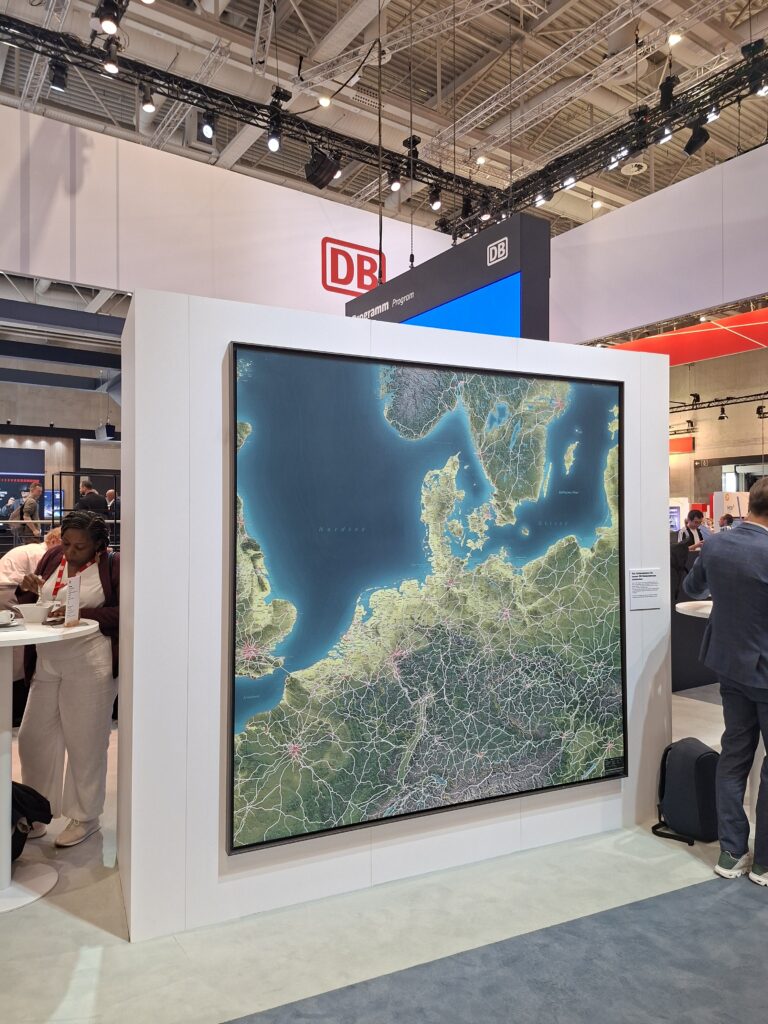
Next to it stood a large, classic map of DB’s network. It still held people’s attention, and I watched visitors trace routes with their fingers. Sometimes the most effective presentation is the most direct one.
RailEvo: rethinking the rail network
RailEvo caught my eye with a near life-size model of its vehicle. CEO Nicola Mosca took the time to explain the concept in detail, and he was clearly convinced of what his team is building.
RailEvo is developing a self-driving, on-demand rail system. Instead of trains on a fixed timetable, individual units travel the tracks when passengers need them. It relies on a patented vertical-switching mechanism and is designed for underused single-track lines, so it needs no new infrastructure. That second point matters. Building new infrastructure is slow and expensive, and creating value from tracks that already exist is the kind of thinking we value in solution management: start from what is there, and make it work better.
Nox Mobility: the night train returns
Nox Mobility used InnoTrans to open bookings for a new night service from Hamburg to Munich, starting in March 2027. It offers two cabin concepts, the Double Loft and the Single Loft, with a Suite version planned for later. Nox developed them with feedback from close to 50,000 people in its early-access community, which is a strong way to make sure a product meets real needs.
The visit itself was less convincing. The stand was crowded, the seats were simpler than I expected, and the bed mock-ups looked less polished than the pictures online. But a fair shows products in progress, and I am curious to see the final version at launch.
National Railway Office (ONCF) Morocco: a whole country’s network
Most stands presented a product. The Moroccan stand presented a country’s ambition. A representative walked me through the new high-speed rail programme, part of an investment of more than $10 billion through 2030. It includes extending the high-speed line from Kenitra to Marrakech and buying 168 new trains from Alstom, CAF and Hyundai Rotem.
As a North African, I was proud to see a project of this size represented at an international fair. It also changed my perspective. A new seat or a smarter app improves one part of the journey, while a national network shapes the whole of it. Large programmes like this create demand for the technologies shown in every other hall, and those technologies only reach people when someone builds the network to carry them. We see the same in solution management: a single solution has value, but its full impact comes when it fits into a larger system.
The people behind the projects
These four stands had little in common at first glance, yet each put the traveller at the centre. What I valued most, though, were the conversations. One of my goals for InnoTrans was to build my network, and I spoke with managers, experts, CEOs and engineers. What was most fascinating was hearing them explain why their work mattered and who it would help. Behind every vehicle and every algorithm there is a team that has spent years on one hard problem, and you could hear it.
Four days, 42 halls, 3,170 exhibitors. In the end, it came down to talking to people, one conversation at a time.
By Aya Bahri, Working Student in Solution Management
Let’s talk possibilities!
Every project on this page started with a conversation about a real operational challenge. Bring us yours, and let’s explore what a working prototype could look like.