Workforce Analytics That Answers Back
Workforce analytics with the questions your team asks every week already built in, and a natural-language layer for the questions nobody has built a report for.

In a Nutshell
- Instant Conversational Data: Replaces ticket queues with a natural-language query interface, delivering instant visual chart responses to plain-language workforce questions.
- Unified Data Model: Combines curated operational dashboards with a single governed data layer, cutting report delivery costs by ~30%.
- Automated Validation: Features an integrated verification layer around generated queries to guarantee data precision before display.
The Catalyst
At most organisations, the questions that get answered well are the ones somebody built a dashboard for two years ago. Everything else joins a queue. A team lead wants to know why one site’s overtime has climbed three months running. They raise a ticket. The data team has a backlog two weeks deep. The answer arrives in time to be filed, not in time to shape the budget conversation it was meant to inform.
That delay used to be the cost of working with data. It isn’t any more. People now ask their phones and their search bars questions in plain language and get an answer back in seconds, and they have started to expect the same of the tools they use at work. Workforce platforms hold years of operational data, and the people closest to the decisions remain the furthest from reaching it. That is the gap worth closing.
The Method
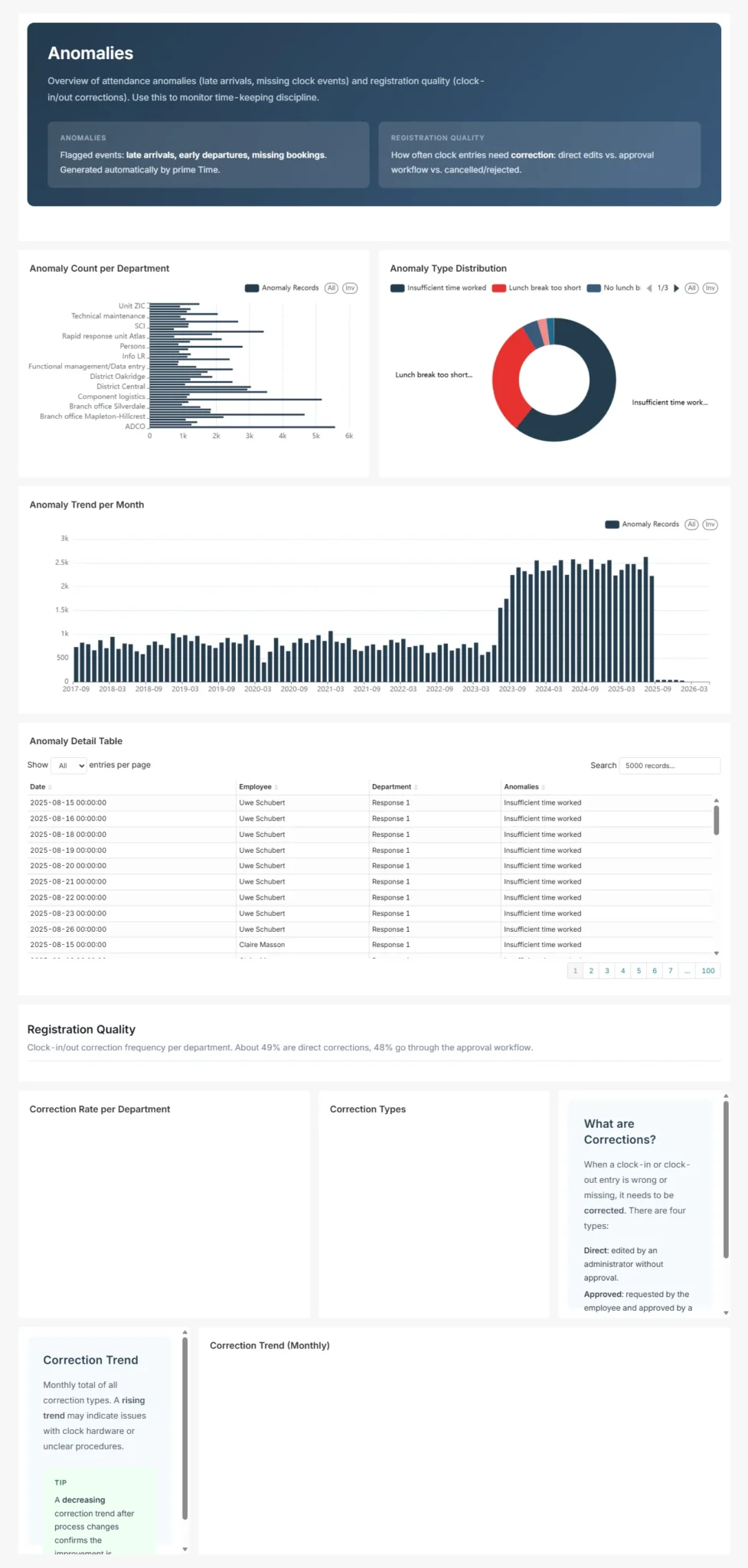
Primion’s Analytics platform brings both routes into one place on a single consolidated data model. The first is a curated business-intelligence layer built on a well-established open analytics stack, covering the recurring dashboards a workforce team needs day-to-day. The second is a multilingual natural-language layer that turns a plainly worded question into a query and returns with the data in an answer generating the respective charts.
Picture a regional operations lead who spots a sickness spike at one site. In the old flow, that’s a brief to an analyst and a wait. In the new flow, they type the question directly: show me sickness by site for the last six weeks against the previous quarter. The chart returns in seconds. They follow up: now break that down by shift pattern. Another chart. They have what they need before the meeting it was meant to inform.
The platform is designed to answer anything related to workforce data. Every generated answer passes through a validation layer before it reaches the user, because turning a loose human question into a correct query is genuinely hard, and we treat it that way.
The Components
- Consolidated workforce data model
Multiple source systems feed one governed model, so every question is answered against the same picture rather than reconciled across spreadsheets after the fact. - Curated dashboards
Live with customers today, built on a proven open analytics foundation. They cover the recurring shape of workforce questions: attendance, absence, overtime, capacity and sickness patterns over time. - Natural-language querying
Running in a proof of concept with an enterprise customer. A user types a question in natural language, the platform generates the query, and a charted answer comes back in seconds. Multilingual from the outset. - Charts as answers, not tables
Results arrive in a form a manager can read between meetings, not a grid of rows waiting to be interpreted. - Quality checks on generated answers
Validation wraps every model-generated query, so reliability tightens with each real question the prototype meets.
End the Wait Between Question and Answer
The value of this model is measurable in both cost and speed. A significant share of data effort is typically spent before analysis even begins. In many cases, 60 to 80 percent of the work required to deliver a new use case goes into finding, preparing, and validating data, much of it a one-time effort. When that work is rebuilt for each request, cost scales linearly and time to insight stays slow.
Consolidating data into a reusable model changes that curve. Supporting multiple use cases from a single data foundation can reduce delivery costs by around 30 percent.
At the same time, value is captured faster. With each additional use case building on existing data, organisations can accelerate the speed of value realisation, in some cases by as much as 90 percent.
The impact is cumulative. Each new question becomes cheaper and faster to answer than the last. Instead of rebuilding data for every request, the organisation compounds value on top of what already exists. For workforce analytics, that shifts performance in three ways. Decisions are made sooner, while signals can still be acted on. Cost per insight falls as reuse replaces rework. And capacity is released from data preparation into higher-value analysis.
This is where the model pays off, not in a single report, but in how every subsequent question is answered.
The Experiment
The platform is already in use, answering real workforce questions against live data.
The Analytics layer is now being piloted with customers, working directly with operational teams and real-world scenarios. Each interaction improves how it interprets questions, structures queries, and returns answers that can be acted on immediately.
What comes next is expansion. Broadening the range of questions it can handle and accelerating how quickly it learns from real usage. To do that, we are opening a limited pilot to a small group of Primion customers.
This is not just early access. It is participation in how the platform evolves. The questions your teams ask directly shape what the platform learns to answer next. If access to workforce data is still mediated by tickets, queues, or specialist support, this is the opportunity to remove that constraint.
Speak to your Primion account manager to join the pilot.
Let’s talk possibilities!
Every project on this page started with a conversation about a real operational challenge. Bring us yours, and let’s explore what a working prototype could look like.